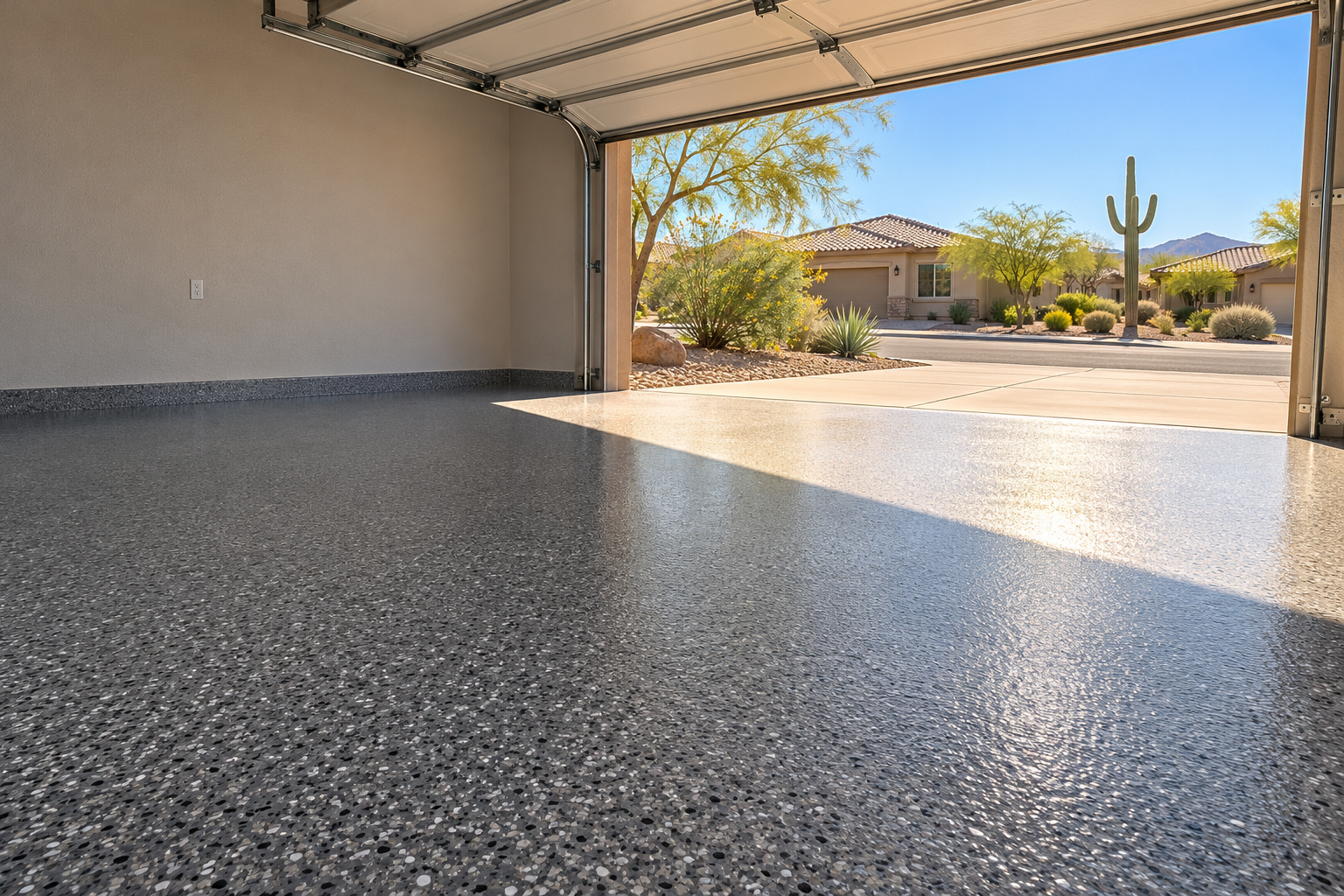
How Arizona Heat Affects Garage Floor Coatings in Buckeye
Quick answer: Can garage floor coating be installed during Buckeye's hot weather?
Yes, potentially—but suitability depends on measured concrete temperature, ambient conditions, slab moisture and the particular coating product. Buckeye's desert heat can shorten working time for some two-part materials and affect the coating process. A qualified installer should compare actual on-site measurements with the manufacturer's technical data sheet, not assume that any warm day—or any epoxy product—is suitable.
The decision checklist before you request a quote
First, ask whether your slab has previous coatings, oil contamination, cracks or visible surface weakness. Second, ask what concrete surface profile the proposed system needs and how the crew will obtain it. Third, confirm whether moisture testing is appropriate for your selected product. Fourth, ask for a written installation schedule specifying acceptable conditions, cure windows and vehicle return-to-service. A polished photograph does not replace these checks.
Why careful preparation is also a safety issue
Mechanical grinding and other concrete preparation methods can generate respirable crystalline silica. OSHA's silica safety guidance describes controls that trained crews may need when cutting or grinding concrete; homeowners should not attempt contractor-grade surface preparation without appropriate equipment and expertise. Ask how the contractor will manage dust, nearby belongings and access to your home during installation. For a local estimate, start with the Buckeye Epoxy Floor project team after the exact site URL and active service details are confirmed.
Why Heat Matters To A Garage Coating
Buckeye homeowners often think first about appearance when considering a garage floor coating: a cleaner surface, a finish that complements the home, and a floor that is easier to maintain. Yet the conditions in a desert garage can matter as much as the color. The substrate, air temperature, direct sunlight, humidity, and actual coating product all influence installation planning. A surface can be considerably warmer than the air, particularly near a sun-facing garage opening. For that reason, installers should evaluate actual site conditions rather than rely only on the weather forecast.
Start With The Concrete, Not The Coating
A coating depends on its bond to the underlying concrete. Dust, oil, grease, tire residue, curing compounds, old paint, and weak surface layers can interfere with adhesion. An installer may use mechanical grinding or other appropriate surface preparation to establish a profile consistent with the chosen system. Simply sweeping and rolling on a product is not a reliable substitute for inspecting the floor. Visible cracks, spalling, uneven areas, and previous coatings should also be discussed before work begins. Some defects require repairs or special treatment, while certain movement joints may need to remain functional.
Check Moisture Even In A Dry Climate
Arizona's dry reputation does not mean every concrete slab is moisture-free. Water can move through concrete from below or enter from irrigation, cleaning, plumbing problems, or other sources. Moisture and vapor conditions can affect some coating systems. A contractor should decide whether the slab needs appropriate moisture testing based on the system manufacturer, project history, and site assessment. Surface appearance alone does not establish suitability. If results exceed a product's limits, the remedy might involve a compatible moisture-management system, additional investigation, or a revised installation plan.
How Temperature Changes Application Planning
Every coating has a technical data sheet specifying application conditions, mix ratios, pot life, recoat windows, and cure requirements. High temperatures may reduce the working time available after components are mixed; some formulations respond differently than others. The goal is not simply to apply a coating as fast as possible. It is to follow the specific system's requirements while maintaining consistent coverage and finish. Scheduling earlier in the day, controlling direct sunlight, or using a different manufacturer-approved system may be practical options. Product-specific guidance must control any decision.
Epoxy, Polyaspartic, And Other Systems
Homeowners may hear several product names during estimates. Epoxy is widely used as a floor-coating chemistry, while polyaspartic and other systems may be proposed as topcoats or alternatives. Their performance cannot be summarized accurately by claiming that one material always cures faster or lasts longer. Formulation, preparation, film build, exposure, maintenance, and the installer’s process all matter. Ask which primer, broadcast material, and topcoat are included, and request the product data sheets. If slip resistance is important, discuss the finish texture and the tradeoff between traction and ease of cleaning.
What To Ask Before Scheduling
Request a written assessment that identifies floor condition, proposed preparation method, crack treatment, coating layers, expected access restrictions, and specific return-to-service instructions. Ask where vehicles and stored items should go during the project. Homeowners who use a garage as a workshop should disclose chemical spills, heavy rolling equipment, or other unusual exposure. Confirm any warranty terms in writing, including what they do and do not cover. A good estimate explains the complete process rather than quoting only a price per square foot.
Care After The Coating Has Cure
Follow the contractor's and product manufacturer's instructions for foot traffic, vehicle parking, washing, and chemical cleanup. Avoid dragging sharp or heavy objects across the finish and use appropriate protective pads under equipment where recommended. Remove grit and sand regularly, because abrasive debris can wear surfaces over time. Clean spills promptly with a cleaner compatible with the coating. If a small area becomes chipped or begins to peel, document the issue and contact the installer before applying a random repair product that may not bond properly.
Frequently Asked Questions
Can you coat a garage floor during a Buckeye summer?
Sometimes, but only when measured conditions meet the chosen product’s application limits.
Does dry weather eliminate moisture testing?
No. Dry air does not establish the moisture condition of the concrete.
How long before I can park my car?
Follow the installer’s written product-specific return-to-service instructions.
Does every floor need grinding?
Preparation must match the slab and the manufacturer’s requirements.
Plan Your Buckeye Garage Project
A durable, attractive floor begins with a realistic assessment of the concrete and a product-specific installation plan. Contact Buckeye Epoxy Floor to request a garage floor assessment, discuss your preferred finish, and obtain a written estimate and project timeline before work begins.
Schedule a garage floor assessment to get started.
