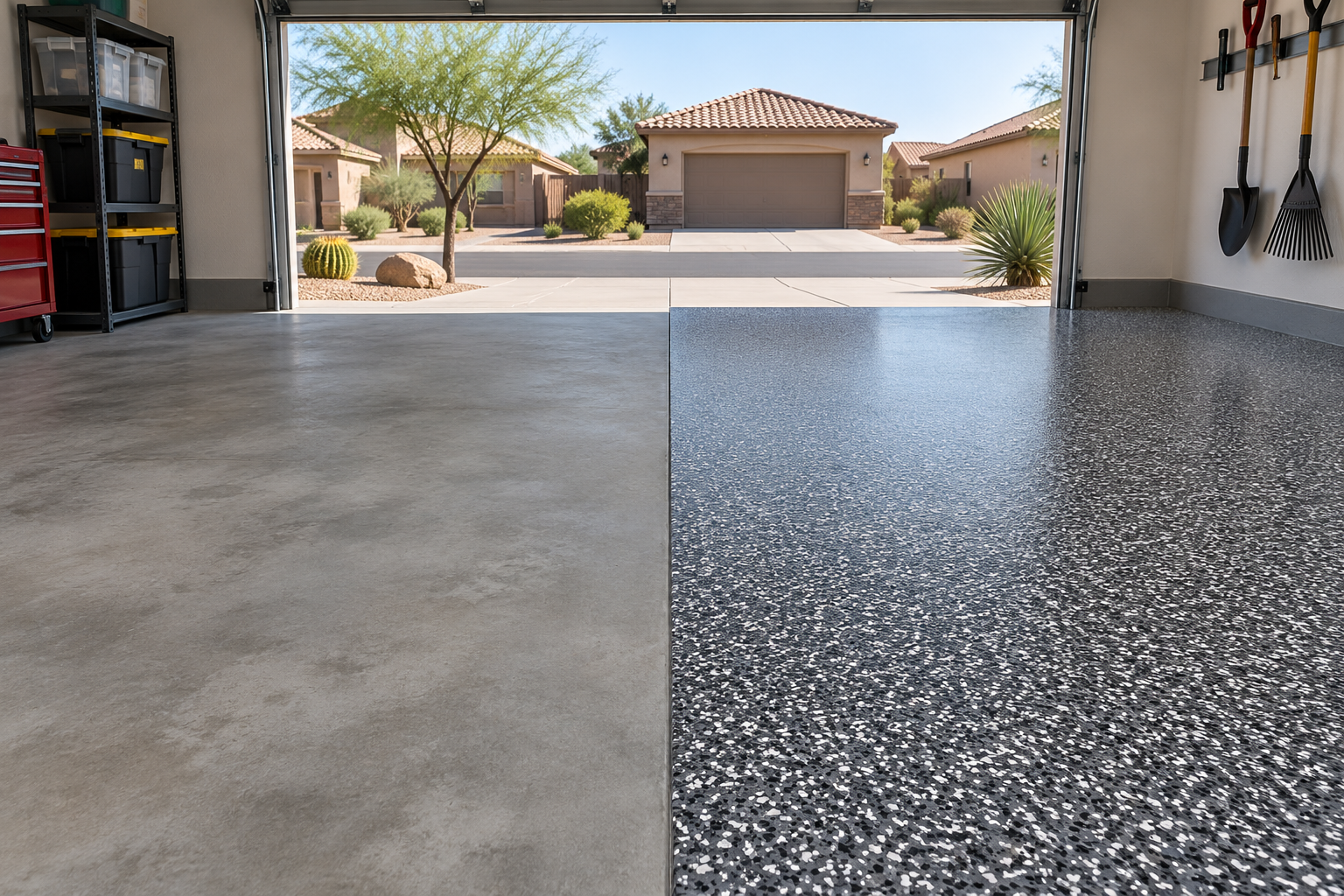
Epoxy vs. Bare Concrete: What’s Better for Your Buckeye Garage?
Short answer: neither is best for every garage. A coating can make a stained, dusty floor easier to clean and give it a finished look. Bare concrete can be a reasonable choice if the slab is sound, your budget is tight, and you can live with some dust and staining. The better option depends on your budget, the concrete’s condition, your cleaning expectations, and how you use the space.
First, a clarification: epoxy isn’t a different flooring material. It’s a coating applied over your existing concrete slab. The real comparison is a coated slab versus an uncoated one.
Buckeye Epoxy Floor lists garage floor epoxy coating among its services for Buckeye homeowners. This guide covers the tradeoffs so you can decide whether an epoxy garage floor in Buckeye, AZ fits your home.
Epoxy-Coated vs. Bare Concrete Garage Floors at a Glance
Factor | Bare concrete | Epoxy-coated concrete |
Upfront cost | No added cost | Added cost; varies by size, repairs, prep, and system |
Cleaning | Porous; spills can soak in | Sealed surface that usually wipes clean more easily |
Dust and spills | Can shed fine dust and absorb oil | Can reduce dusting; spills still need prompt cleanup |
Appearance | Plain gray; stains and patches show | Color and decorative options, depending on system |
Wear | May stain, pit, or dust | Can chip, peel, or show marks if prep or product fails |
Surface prep | Minimal | Essential and often labor-intensive |
Downtime | None | Garage unavailable during install and cure |
Moisture | Vapor passes through unnoticed | Trapped vapor can cause blistering or peeling |
Wet traction | Varies; smooth concrete can also be slick | Can be slick when wet unless traction is added |
Future upkeep | Optional resealing | May need repair, a topcoat, or recoating over time |
When Bare Concrete May Be Enough
Leaving the slab uncoated can make sense when:
The floor is sound, without major cracks, flaking, or heavy stains.
The garage is mainly for parking, and a utilitarian look is fine.
Your budget is better spent elsewhere right now.
You’re comfortable sweeping and degreasing spills promptly.
The tradeoff is that concrete is porous. Oil and other fluids can soak in, and the surface may dust. A concrete sealer is a middle option. Buckeye Epoxy Floor’s website also lists concrete sealing, so ask whether sealing or coating fits your slab better.
What an Epoxy Garage Floor Coating Can Offer
Epoxy coatings combine a resin and a hardener that cure into a hard film. Done well, a coating can offer:
Easier cleaning. A sealed surface generally wipes up more easily than raw concrete.
Less dusting. The film covers the porous slab.
Spill management. Chemical resistance varies by product, so check the data sheet for the fluids you actually use.
Appearance options. The company’s website mentions quartz, chip, and flake finishes. Ask to see physical samples.
It also has limits:
Sun and yellowing. Standard epoxy isn’t automatically UV-stable. One manufacturer data sheet says its epoxy will yellow with UV exposure and recommends a UV-resistant urethane topcoat. Epoxy, polyaspartic, and polyurethane are different chemistries, and aliphatic polyurethane and polyaspartic are commonly used as UV-stable topcoats. Ask exactly which layers your quote includes.
Traction. Coatings can be slippery when wet, and additives can improve grip.
Not a structural repair. A coating won’t stop a slab from cracking.
Not maintenance-free. Hot tires, abrasion, and impact can still damage a coating.
What Buckeye Homeowners Should Consider Before Installation
Concrete condition and preparation
Coatings bond best to clean, properly prepared concrete. Contaminants, old sealers, and weak surface layers can cause failure. Preparation often involves mechanical grinding or shot blasting, plus cracks and chips repaired beforehand. Repaired cracks can still reappear, so ask how your contractor handles them.
Moisture
Don’t assume an Arizona slab is dry. Concrete isn’t a moisture barrier, and vapor moving upward can blister or lift coatings. Industry moisture tests include ASTM F2170 (in-slab humidity probes) and ASTM F1869 (calcium chloride). Ask what moisture assessment, if any, will be done on your garage.
Heat, sun, and application conditions
Coating data sheets set limits for air temperature, concrete temperature, and humidity. One epoxy data sheet lists an installation range of 50°F–90°F and notes that higher temperatures shorten working time. A sun-heated Buckeye slab may affect scheduling or technique.
Keep two questions separate. One is whether the product can be applied under your conditions. The other is how it performs once fully cured. Ask for the data sheet for the exact system proposed.
Downtime
Cure and return-to-service times depend on the product and conditions. Ask for foot-traffic and vehicle timing in writing, and don’t park on the floor early.
Cost factors
Local pricing varies, so compare itemized quotes. Cost is typically shaped by:
Garage size
Concrete condition and repairs
Preparation method
Number and type of coating layers
Decorative flakes or colors
Topcoat and traction additives
Which Option Fits Your Garage?
Bare concrete (or sealing) may fit if:
The slab is in good condition.
You want the lowest upfront cost.
Appearance isn’t a priority.
A coating may be worth considering if:
Stains and dust bother you.
You want a more finished look.
You want a surface that’s easier to clean.
You’re prepared to maintain it.
Either way:
Have the concrete assessed before deciding.
Ask how moisture, cracks, and heat are handled.
Discuss Your Garage Floor Options With Buckeye Epoxy Floor
Buckeye Epoxy Floor’s website lists garage floor epoxy coating and concrete sealing for Buckeye and surrounding areas, and states that it evaluates your garage floor’s condition. That makes it a reasonable place to compare options.
Before you decide, ask:
Which coating system and topcoat will be used?
How will the slab be prepared?
How are moisture and cracks assessed?
What traction options are available?
When can I walk and park on the floor?
What warranty terms apply, in writing?
Request a free garage floor coating estimate by calling (623) 253-8332 or using the contact form. The website lists weekday hours of 8 a.m.–5 p.m.
Frequently Asked Questions
Does bare garage concrete need to be coated?
No. Sound concrete can serve a garage for years uncoated. Coating is optional and mainly addresses appearance, cleaning, and staining.
Can epoxy be installed over stained or cracked concrete?
Often, after cleaning and repair, but it depends on the slab. Stains and contaminants must be removed or addressed for proper bonding. Cracks should be repaired, though a coating can’t prevent new or repaired cracks from moving.
Are epoxy garage floors slippery when wet?
They can be. Traction depends on the finish and whether additives are used. The company’s website notes that slip-resistant additives can be added to improve grip. Ask to see a textured sample.
How long before you can park on a newly coated garage floor?
It varies by product, temperature, and humidity, so there’s no universal answer. Request the manufacturer’s data sheet for your system and get your contractor’s return-to-service guidance in writing.
